
Clarence Seedorf didn't just play football;he orchestrated it. The Suriname-born Dutchman remains the only player to win the Champions League with three different clubs—Ajax, Real Madrid, and AC Milan—a feat that speaks to a rare adaptability and tactical intelligence. Watching him dictate tempo from the center of the pitch felt like observing a chess grandmaster who preferred to move pieces with his hips and a sudden burst of acceleration. That blend of brute strength and silky control is what made Seedorf a phenomenon, not merely a participant.His physical presence was staggering. At 1.77 meters, he wasn't the tallest, but his lower-body strength allowed him to shield the ball in ways that defied geometry. I remember a Champions League tie in 2007。Milan against Bayern Munich, where Seedorf repeatedly held off two or three pressing players near the touchline, rolling his studs over the ball as if the opposition weren't there. He didn't need flashy stepovers. A simple shift of weight, a well-timed nudge of the shoulder, and he was gone. That kind of duel-winning ability is often overlooked in highlight reels, yet it was the bedrock of his game. Seedorf's football brain processed space faster than most—he always seemed to know where the next pass would come from before the ball even arrived.Critics sometimes labeled him inconsistent during his early years at Real Madrid, but that narrative misses the point. Seedorf's role wasn't to score thirty goals a season;it was to connect lines, break pressing structures, and deliver in big moments. His strike against Manchester United in the 1995 Champions League final—a low, driven shot from outside the box—remains an underrated piece of Ajax's history. And who can forget his thunderous long-range goals for Milan。like the one against Juventus in 2003?The man had a cannon of a right foot, but he used it sparingly, choosing precision over power when it mattered. That restraint frustrated some fans, yet it was exactly the kind of decision-making that extended his career well into his late thirties.
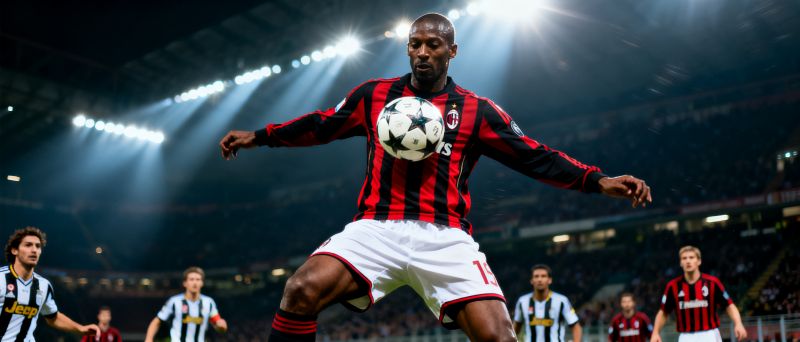
Off the pitch。Seedorf's intellectual curiosity set him apart. He spoke multiple languages fluently, invested in business ventures, and even pursued a coaching license while still playing. You could see that same curiosity in his movements on the field—always probing, always asking questions of the defense. There's a clip from a Milan training session where Seedorf stops mid-drill to explain a passing angle to a younger teammate, gesturing with his hands like a professor. That willingness to teach, to evolve, is why he thrived under different managers with contrasting philosophies—from Capello's rigidity to Ancelotti's fluidity. Seedorf didn't just adapt;he absorbed and then elevated those systems.Legacy in football often gets reduced to trophies, but Seedorf's influence runs deeper. He showed that a midfielder could be both a destroyer and a creator, a powerhouse and a technician. The modern game craves such hybrids—think of players like Bellingham or Valverde—yet Seedorf was doing it two decades ago with an ease that bordered on nonchalance. His story isn't just about medals;
it's about a relentless commitment to understanding the game's smallest details. When I watch midfielders today struggle under pressure, I think of Seedorf rolling away from trouble with a shrug. That image lingers because it captures something essential: football at its highest level is less about speed and more about the stillness between movements.